

Our scientific strategy:
the targeted delivery of gene therapy to the seizure focus
Part one:
Targeted delivery to the seizure focus

In patients with refractory epilepsy, the seizure focus (the part of the brain that causes the seizures) represents less than 1% of the overall brain volume.15

On average, the focus will measure only of 2-3 cubic centimetres,16 roughly the volume of a cherry.

Our approach is to deliver a single dose of gene therapy directly to the seizure focus via a surgical procedure that takes place in a hospital.
During the procedure, a very thin cannula with a diameter of about 1-2mm (thinner than a grain of rice) is inserted into the seizure focus to deliver a volume of about 1ml of gene therapy (Figure 1.). Importantly, our approach does not require the permanent destruction of cerebral tissue, in contrast to resective surgery or laser ablation (or LITT). Furthermore, our approach only treats the seizure focus, in contrast to antiseizure medicines which are distributed throughout the brain and the entire body of patients.

Figure 1: Targeted delivery to the seizure focus
Part two:
Using an engineered Kv1.1 potassium channel to reduce epileptic activity

Our most advanced gene therapy is EPY201 (AAV9-CAMK2A-EKC). EPY201 uses an AAV9 capsid as a vehicle to deliver a transgene coding for an engineered Kv1.1 potassium channel (EKC) to the neurons in the seizure focus.

EPY201 also utilises a so-called CAMK2A promoter to bias the expression of the transgene to excitatory neurons; this ensures that there is a comparatively higher proportion of excitatory neurons in the epileptogenic focus that are transduced with the transgene.

Following the administration of EPY201 to the seizure focus, the transgene allows neurons to increase the production of the Kv1.1 potassium channel, a protein that is naturally present in the brain. This makes neurons less excitable and reduces the release of neurotransmitters.17

As a result, the tendency for local neural circuits to generate seizures is profoundly reduced.
Evidence of potent antiepileptic activity in preclinical models of FRE
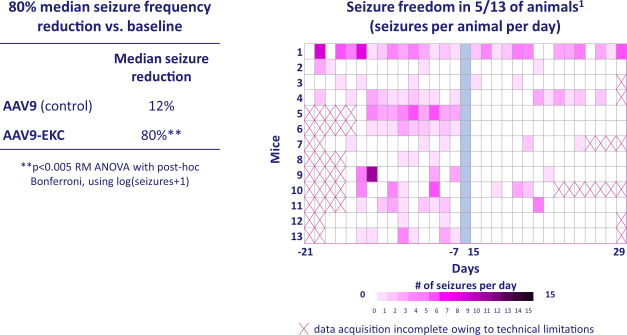
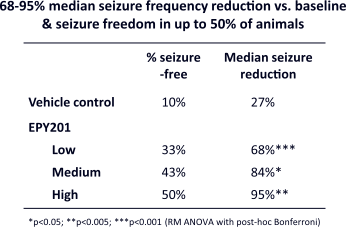
We have demonstrated that EPY201 dramatically reduces seizure activity across multiple subtypes of FRE in preclinical models. Notably, EPY201 has been shown to reduce seizure frequency by over 80% in the two most common subtypes of FRE, focal cortical dysplasia18 (FCD, Figure 2) and temporal lobe epilepsy19 (TLE, Figure 3), respectively. Importantly, there was also evidence of seizure freedom in up to half the treated animals, and EPY201 has been shown to be well tolerated and devoid of adverse effects on behaviour.
Antiseizure effects of EPY201 in focal cortical dysplasia or FCD
Antiseizure effects of EPY201 in temporal lobe epilepsy or TLE
Our next step:
A first-in-human clinical study with EPY201
We are planning to conduct a first-in-human clinical study to establish the safety and tolerability of EPY201, and to demonstrate the antiseizure effects of EPY201 in humans.
Publications about the engineered Kv1.1 potassium channel
There is an extensive body of published data about the efficacy and tolerability of the Kv1.1 potassium channel. Here, we provide a selection of references.
(Science Translational Medicine 2012 Nov 21;4(161):161ra152): Wild-type KCNA1, which encodes Kv1.1, under a cytomegalovirus (CMV) promoter in a lentiviral vector was effective in a model of focal neocortical epilepsy induced by injecting tetanus toxin in the motor cortex. It both prevented epileptogenesis when co-injected together with tetanus toxin, and suppressed seizures when administered once epilepsy was established. No deleterious effect on sensorimotor coordination using tests sensitive to motor cortex lesions. https://doi.org/10.1126/scitranslmed.3004190
(Journal of Neuroscience 2019 Apr 17;39(16):3159-3169): Wild-type KCNA1 under CMV promoter in a lentiviral vector was effective in a second model of focal neocortical epilepsy induced by injecting tetanus toxin in the rat visual cortex. (Detailed model characterization in Chang et al Dis Model Mech. 2018 Dec 14;11(12):dmm036194). Engineered potassium channel (EKC) under a CAMK2A (CaMKII) promoter in a non-integrating lentivector also effective in this model. EKC under the CAMK2A promoter in an AAV9 was also shown to be effective in a rat model of temporal lobe epilepsy. https://doi.org/10.1523/JNEUROSCI.1143-18.2019
(Brain 2020 Mar 1;143(3):891-905): AAV9 CRISPR-mediated transcriptional upregulation of the endogenous mouse Kcna1 gene, which encodes the KV1.1 channel, was effective in a mouse model of temporal lobe epilepsy, and mitigated cognitive co-morbidity (improved spatial memory function) and transcriptomic dysregulation. https://doi.org/10.1093/brain/awaa045
(Science 2022 Nov 4;378(6619):523-532): EKC under a cFos promoter in an AAV9 protected against chemoconvulsant (pentylenetetrazole)-induced seizures after upregulation of EKC transcription. The same viral vector was also effective in suppressing spontaneous seizures in a temporal lobe epilepsy model. Importantly, there was no deleterious effects on hippocampus-dependent behaviours, including contextual fear conditioning, whether tested in naïve animals or following evoked seizures. Efficacy in human cerebral organoids was confirmed using a lentivector. https://doi.org/10.1126/science.abq6656
(Brain 2023 00; 1–12): EKC under CAMK2A promoter in AAV9 (same as in Snowball et al) was effective in a mouse model of frontal lobe focal cortical dysplasia. No deleterious effects on tests sensitive to frontal lobe function. https://doi.org/10.1093/brain/awad387
-
Balter (2012): https://www.science.org/doi/10.1126/science.338.6103.33
-
David et al (2020): https://doi.org/10.1111/epi.16853; Bonelli et al (2010): https://doi.org/10.1093/brain/awq006; Heeroma et al. 2009: https://doi.org/10.1242/dmm.003582; Begum et al. 2016: https://doi.org/10.1038/ncomms12102
-
Heeroma et al. 2009: https://doi.org/10.1242/dmm.003582; Begum et al. 2016: https://doi.org/10.1038/ncomms12102; Vivekananda et al (Proceedings of the National Academy of Sciences USA. 2017;114(9):2395-2400.
-
Almacellas-Barbanoj et al (2023): https://doi.org/10.1093/brain/awad387
-
Data from the EPY201 clinical trial application (CTA)-enabling mouse efficacy study.